
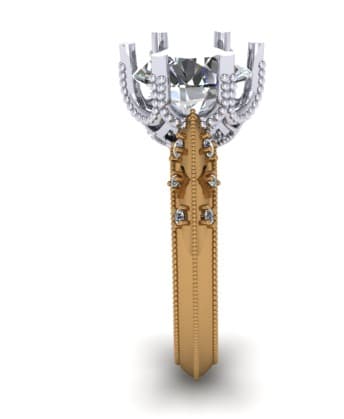
A client walks in with a vague idea — something about their grandmother's ring, a stone they inherited, a style they saw somewhere online. They are not sure exactly what they want. What happens next determines whether they leave with a commission or walk out to think about it.
For a jeweler who can sketch, the answer is simple: you pick up a pencil and draw it in front of them. Right there. In two minutes, you have made the abstract tangible. The client can see their idea — respond to it, refine it, get excited about it. The commission closes.
This is counter sketching. And in an industry increasingly dominated by CAD renderings and 3D prints, it remains one of the most powerful sales tools a jeweler can have.
Why the sketch works when words do not
Clients struggle to describe jewelry. They reach for analogies, gestures, and half-remembered references. "Kind of like this, but more delicate — and maybe the stone sits a bit higher?" That sentence could describe twenty different rings.
A sketch cuts through that ambiguity immediately. When you draw in front of a client, two things happen: the design takes shape, and the conversation becomes concrete. The client stops describing and starts reacting. "Yes — but can the band be thinner?" Now you are refining, not guessing.
The sketch is also a commitment mechanism. Once a client has watched their idea come to life on paper — has pointed to it, discussed it, and nodded at it — the psychological distance between idea and order collapses. The piece already feels real to them.
What makes a counter sketch different from a rendering
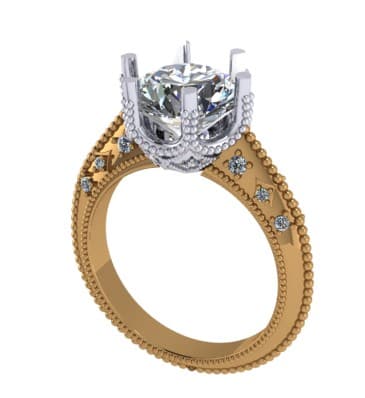
A photorealistic CAD rendering is impressive. But it comes after the design has been decided — it is a confirmation, not a conversation. It takes days, not minutes. And it does not happen at the counter, in the moment when the client is most engaged.
A counter sketch is a live design tool. It is imperfect by design — the roughness signals that this is a working drawing, not a finished proposal. That makes it easier for clients to suggest changes without feeling like they are rejecting something completed. The conversation stays fluid.
The best counter sketches are not technically perfect. They are clear, proportionally accurate, and fast. They show the setting style, the stone relationship, the overall silhouette. Everything a client needs to say yes — and nothing that slows you down.
A skill worth developing — or outsourcing
Counter sketching is a learnable skill, but it takes time to develop confidence. Not every jeweler has it, and that is not a failing — it is just a gap in the toolkit that can be filled.
For jewelers who want the capability without the years of practice, outsourcing counter sketches and design drawings to someone with the skill is entirely practical. The key is turnaround — a counter sketch needs to arrive fast enough to keep the conversation going, whether that means same-day or next-morning delivery for remote consultations.
The goal is always the same: give the client something to react to. Once they can see the piece, the sale takes care of itself.
The bottom line
Digital tools have transformed jewelry design in genuine and valuable ways. But the counter sketch has not been replaced — it has just been underused. For closing custom commissions, building client confidence, and keeping design conversations alive in the moment, nothing works quite as well as a clear, fast drawing done in front of the person who is about to say yes.
Todd Michael
Master jeweler and founder of Virtual Goldsmith. 40+ years of hands-on goldsmithing experience across custom design, CAD modeling, and jewelry illustration.